Showing posts with label Refurbished phones cheap. Show all posts

Thursday, April 4, 2013

Discount Cellular Phones-Meet The HTC First, The First Android Phone To Come Preloaded With Facebook Home

Meet The HTC First, The First Android Phone To Come Preloaded With Facebook Home-Discount Cellular Phones

44
 
 
The torrent of leaks these past few days haven’t left much to the imagination, but HTC’s Peter Chou has just officially pulled back the curtain on the first phone to ship with Facebook Home — the HTC First — at Facebook’s Menlo Park headquarters.

According to HTC CEO Peter Chou the First will be the “ultimate social phone,” though he declined to dig into the device’s specs during his brief moments on-stage. The device will ship in four colors, and will support AT&T’s LTE network right out of the gate. Can’t wait for your chance to take it for a spin? The First will be available for $99 (with a 2 year contract naturally) starting on April 12, and pre-orders for the device kick off today. Those of you outside the U.S. will be able to join in the fun shortly too, as Mark Zuckerberg also noted that the phone would find its way to UK carriers Orange and EE in short order.

The mid-range First will be available in black, white, red and blue, and sports a 4.3-inch display that jibes with earlier reports. Facebook Home obviously serves to obscure the Android 4.1 Jelly Bean build that’s actually running the show, while one of Qualcomm’s dual-core Snapdragon 400 chipsets (and not the MSM8960 that was previously reported) provides the horsepower from inside that smooth, curved chassis. It’s not a bad looking phone and the internals aren’t quite as lousy as many had expected them to be, but all this begs a very important question — will anyone actually buy this phone when you can fire up Facebook Home on your (supported) Android handset for a whopping zero dollars?

I mean, c’mon — I’m a sucker for even mildly neat hardware, but so far neither HTC nor AT&T (whose CEOs both appeared on-stage to talk about how darned great the thing is) could provide a compelling reason why it’s worth buying. LTE? A handsome design? Neither of those are exactly hard to come by these days, are they? Facebook has said that the First will feature better integration for all those notifications you’re bound to get than if you had just installed the app, but at this point there’s little way of knowing how big a difference it’ll actually make. HTC knows how to make great hardware and I don’t mean to diminish that, but a lame device that’s been put together well is still a lame device.

This marks the second time that the social networking giant and the beleaguered Taiwanese OEM have collaborated on a peculiar hardware play. The first, if you’ll recall, were HTC Status (nee Chacha) and the Salsa released back in 2011– their main claim to fame was a dedicated Facebook button for quick access to your friends and feeds. Considering that neither device was exactly a runaway hit, it’s no surprise to see that Facebook and HTC have taken things in a different, more substantial direction with the One. Of course, the First is going to be the tip of the iceberg when it comes to Facebook Home devices — Zuckerberg also pointed to a Facebook Home Program which allows hardware manufacturers to build Facebook Home into their own forthcoming handsets.

facebook phone


Visit our ONLINE STORE for a complete selection of discount cell phones, used cell phones, refurbished cell phones as well as new and used tablets.


Friday, March 29, 2013

used cell phones online-Galaxy S4 priced at $249.99 with contract at AT&T

used cell phones online-Galaxy S4 priced at $249.99 with contract at AT&T

AT&T said customers can pre-order Samsung's flagship phone on April 16. A launch date hasn't yet been given.

Introducing Samsung's Galaxy S4

AT&T said today it would begin taking pre-orders for the Samsung Galaxy S4, which it is pricing at $249.99 with a two-year contract.

Eager customers can place their order starting April 16. AT&T hasn't yet announced when the smartphone would actually hit stores, and a representative declined to provide a specific date.

            Get Cell Phones Cheap at www.mylancellular.com


The $249.99 price tag is slightly higher than the standard flagship phone, which typically retails at $199.99. But Samsung and its carrier partners are hoping that the Galaxy brand, the improved specifications, and the strong buzz behind the product will drive sales. AT&T confirmed that the $249.99 price is for the 16GB base model.

The Galaxy S4 is expected to be the big seller early in the year ahead of the launch of the next iPhone. Still, the phone faces improved competition from the likes of the HTC One, as well as a big marketing campaign from BlackBerry and its Z10 and Q10 phones.

While AT&T is mum about the launch date, T-Mobile Chief Marketing Officer Mike Sievert said that its Galaxy S4 will launch on or before May 1.


Please visit our ONLINE STORE for a complete selection of discount cell phones, used cell phones, refurbished cell phones as well as new and used tablets.

Cell Phones New York-Apple envisions future iPhone with wrap-around display

Apple envisions future iPhone with wrap-around display-Cell Phones New York

A newly published Apple patent application describes a future smartphone with a transparent body and a flexible wrap-around display.

The iPhone of the future?
(Credit: Apple/USPTO)
 
Your iPhone of the future may come with a clear glass body and a display that wraps all the way around.
Published today by the U.S. Patent and Trademark Office, the patent application known simply as "Electronic device with wrap around display" highlights a phone or other electronic device that dispenses with the current flat design in favor of something much more flexible.

The display itself would unwind, or unroll, around the device to reveal a wider array of items. As a result, more space would be available to display icons, photos, videos, and other content.
Users would interact with the device using touch gestures rather than physical buttons. For example, swiping along one of the sides could lock and unlock the device as an alternative to using the current hold button. That innovation would've pleased the late Steve Jobs, who always envisioned an iPhone without any physical buttons.

The body itself could be made of glass, which would offer transparency and be strong enough to support the entire device.

The patent filing points out one potential pitfall. If the display wraps around the entire device, how would the phone figure out the location of the user? The device would use cameras and facial recognition technology to track the position and movement of the user's face and adjust the display in response.

Offering a touch of 3D, the device could even include two flexible displays, one on top of the other. The same content would appear on both displays but would be slightly out of phase on one display versus the other. "In this way, an illusion of depth perception can be presented mimicking a 3D experience," the patent explained.
Flexible displays have been on Apple's mind for while. The company filed for the "Electronic device with wrap around display" patent in 2011 and filed a similar patent called "Electronic Devices With Flexible Displays" last year.

A bendable, flexible display is hardly a new concept in the tech field. But if Apple's patents are approved and the company actually uses the technology, the iPhone could once again outshine its smartphone rivals as a more innovative device.

But Apple better not sit still. Competitors such as Samsung, LG, and Nokia have already demoed their own flexible screens for mobile devices. Samsung is reportedly moving forward on mass production of such displays for release in the first half of 2013, according to a Wall Street Journal story published last November.
(Via AppleInsider)

Thursday, March 28, 2013

unlocked cell phones cheap-Windows RT in trouble? Report makes cryptic claims

Windows RT in trouble? Report makes cryptic claims-unlocked cell phones cheap-

Windows RT merged into Windows Blue? An Asia-based report doesn't provide much clarity for the claim.
 

As Asus RT device.
As Asus RT device.
(Credit: Asus)
Windows RT has not gone swimmingly so far for Microsoft, but a new report from Asia is taking this a step further, saying it will be "merged" with Windows Blue.
Digitimes' reporting can sometimes be frustratingly vague. A new report continues the tradition but makes a potentially important claim that Windows RT will be merged into Microsoft's "next-generation Windows, codenamed Blue."
Here's what the Taipei-based news site said is the basis of merging RT into Blue, citing Asia-based suppliers.

Although the PC supply chain had pushed the Windows on ARM (WoA) platform aggressively, the Windows RT's name, which has misled most consumers into believing that the operating system is able to support all existing x86 Windows programs...the lack of apps, as well as compatibility issues have all significantly damaged demand.

The report could be written off as just more odd musings from the "supply chain" if not for persistent negative comments from PC makers about Windows RT and outright rejection of the platform from some of the biggest PC makers such as Hewlett-Packard and, more recently, Samsung.
That said, it should also be noted that supply chain gossip can often be misinterpreted, as things get lost in translation when they go from the source -- in this case Microsoft -- to the supplier and then to the media.
And it's not clear what merging RT into Blue means exactly. Microsoft has been equally cryptic about what Windows Blue is, saying only that Microsoft is working "on plans to advance our devices and services, a set of plans referred to internally as 'Blue.'"
And as recently last week, Microsoft said that Windows RT is just fine, according to an interview with Michael Angiulo, a corporate vice president.

Cellular Phone Refurbished-Despite Google patent efforts, VP8 no shoo-in for Web video

Despite Google patent efforts, VP8 no shoo-in for Web video- Cellular Phone Refurbished-

Nokia refuses to license patents it says are needed to use Google's video technology, sullying Google's earlier patent deal. But WebRTC could still spread VP8 widely, lowering Web video costs for startups and schools.
 Get Cell Phone Cheap Today at www.mylancellular.com
 

Justin Uberti, a WebRTC leader and VP8 advocate at Google, speaking at Google IO 2012.
  
A Google patent-licensing deal two weeks ago dramatically improved the fortunes of its VP8 video technology, but Nokia has added a barricade to what has already been an arduous road to adoption.
VP8 is a codec -- technology to encode and decode video or audio data for compact storage and efficient network streaming. Despite passionate debates about VP8 vs. the incumbent codec, H.264, most people need never care about video codecs.
But as video becomes ever more deeply embedded in the Net -- TV entertainment, chatting with friends, videoconferences for business, online schooling for children -- the video codec issue becomes ever more important. At stake in the current debate is whether H.264 and its big-business licensing terms will prevail, or whether there also is room for an open-source, free-to-use alternative that could give an edge to cash-strapped startups, schools, and self-publishers.
Spreading VP8
Google and allies including Mozilla want to build VP8 into the workings of the Net as a royalty-free technology. The current focus for the debate is WebRTC, a technology for Web-based chat that members of the Internet Engineering Task Force are standardizing.

Two weeks ago, Google announced a VP8 patent deal that could have helped persuade IETF members that VP8 support should be a mandatory part of WebRTC.
WebRTC has a lot of momentum -- it's even got its own conference -- so it could conceivably carry VP8 all around the Net. That would start with browsers, but then could extend into smartphone processors, video-streaming sites, set-top boxes, and video cameras.
Google's patent deal was with MPEG LA, which licenses pools of video patents used for various standards, and it cleared some of the clouds of intellectual-property risk that loomed over VP8.
But Nokia last week told IETF members that it's got patents that bear on VP8. And in discussions about the related WebRTC, an IETF standard for browser-based audio and video chat, efforts so far have failed to produce consensus that VP8 should be required as mandatory to implement (MTI).
Google has steadily pushed for years its aspirations for royalty-free video on the Web, including through its $123 million acquisition of VP8 developer On2 Technologies. WebRTC gives Google, Mozilla, and others a second chance to build VP8 into the workings of the Web -- something they failed to do years earlier when hammering out how to build video directly into the standard for Web pages themselves, HTML. WebRTC is built into Chrome and Firefox and about to arrive in Chrome for Android, and developer adoption would help spread VP8 far and wide.

WebRTC logo
 
Patents are a significant problem to VP8 and its use in WebRTC, but not the only barrier. The biggest issue, arguably, is simply that the industry so far has largely coalesced around H.264, aka AVC, and it looks likely to move smoothly to its successor, H.265 aka HEVC.

The technology is well-understood and broadly supported. With H.264, makers of Web browsers, video cameras, mobile-phone processors, and DVDs pay royalties to MPEG LA which licenses a pool of patents for the codec.

Computing industry players are accustomed to H.264 royalty payments -- indeed, Cisco would like H.264 to be the mandatory WebRTC codec. But that price is a big deal to smaller players.
"Speaking as a developer working for a company with much less money than yours," Lorenzo Miniero of Web-based videoconferencing company Meetecho told Cisco in a mailing list post, "if the IETF selects H.264 as the MTI codec, this will make it even more dramatically difficult and expensive (if not impossible) for pretty much everybody else to use WebRTC."
Also, patent-encumbered technology is fundamentally at odds with open-source software such as Mozilla's Firefox, and therefore can't tap into the energy and cooperation of open-source programming.
Google works to steadily improve the performance and image quality of its software for encoding and decoding VP8 video. It does the same with offers freely available technology that lets chipmakers build VP8 support into hardware. This graph shows the latest hardware encoder, Foxtail, producing significantly higher quality than the first-generation Anthill version at the same network transmission rate. Alternatively, it offers the same quality at a lower bitrate. Foxtail also beats out Duclair; the decoding software.
Google works to steadily improve the performance and image quality of its software for encoding and decoding VP8 video. It does the same with freely available technology that lets chipmakers build VP8 support into hardware. This graph shows the latest hardware encoder, Foxtail, producing significantly higher quality than the first-generation Anthill version at the same network transmission rate. Alternatively, it offers the same quality at a lower bitrate. Foxtail also beats out Duclair; the decoding software.
(Credit: Google/WebM) 
 
"Having open-source codecs will allow for faster acceptance and faster improvements to the codec by the development community," said Paul Greenlea, a programmer and strategist at development shop Fresh Tilled Soil, which just published a demonstration of WebRTC-based chat using Chrome running on a Google Nexus 7 and on a MacBook Air
.
Google works hard to improve VP8 as part of the higher-level WebM project, which bundles VP8 and the Vorbis audio codec for streaming video. Periodic releases of freely available VP8 encoders and decoders technology, usable either as software libraries or for building into video hardware, show steady improvements in image quality at a given network transmission data rate.

Google's MPEG LA patent deal

Google's VP8 deal with MPEG LA, announced earlier this month, gave Google "a license to techniques that may be essential to VP8" held by 11 patent holders.
One snag, though: In 2011, 12 organizations came forward to say they had VP8-essential patents when MPEG LA said it was investigating the formation of a VP8 patent pool.
Nokia, apparently the 12th company, isn't playing along. "The declaration says that Nokia is not prepared to license the listed patents for RFC 6386 under any terms," Nokia's Markus Isomaki said on the IETF's WebRTC mailing list. RFC 6386 is a Google description of VP8 at IETF.
In addition to trying to coax the tech industry to adopt VP8 as mandatory in WebRTC, Google is trying to standardize VP8 itself. In January, it brought VP8 to the International Organization for Standardization, submitting VP8 to the ISO working group known as the Motion Picture Expert Group (MPEG). That's the very group that produced H.264 and its brand-new sequel, HEVC/H.265.
VP8 allies had hoped to convince WebRTC standards group members that VP8 should be a mandatory-to-implement codec. At a November 2012 meeting, the WebRTC group was set to see if there was consensus on the matter -- but Google abruptly yanked the item off the agenda and pushed it back to the next IETF meeting in March.

WebM logo
 
The MPEG LA deal arrived shortly before the March meeting was set to begin, though. Among those who bridled to see the agenda including a WebRTC codec discussion were representatives from Apple and Microsoft, two companies that are big H.264 fans; they wanted more time to digest the MPEG LA deal and more information about what companies are actually involved in it.
"The decision rests on (at least) late-breaking news, and unavailable information, and I am opposed to any move to get a formal decision for a mandatory video codec at the meeting," Apple's David Singer said in a mailing list message. "There is some very important data (notably, the names of the 11 and the resulting license) which is promised to be available in only a few weeks. Let's not decide in haste (and possibly repent at leisure)," he added.
And Microsoft's Matthew Kaufman said Google's announcement "was posted too late to be of any value for this meeting."
Ultimately, the IETF group again postponed WebRTC codec issue.

Catching the mobile wave

 But that was just agenda wrangling. In another high-traffic discussion item, Internet giant Cisco championed H.264 as the mandatory WebRTC codec, arguing that VP8 would hold the standard back. It came from a post by Jonathan Rosenberg, chief technology officer of Cisco's cloud collaboration group:
I would like to suggest that, at this time, adoption of VP8 as MTI [mandatory-to-implement codec] will slow down adoption of WebRTC by turning off developers that would otherwise embrace it if H.264 were selected...

The reality is [that] today's Internet communications systems are built on H.264. And unless the developer cares only about living within the island of the web browser, a VP8 based solution will simply not meet their requirements...
If IETF selects VP8 as the MTI codec, this will make it dramatically more difficult and expensive for us to use WebRTC.
Google employees offered rebuttals. Google's Justin Uberti objected to the idea of the Web as an island, referring indirectly to the number of Firefox, Chrome, and Chrome for Android browsers that support WebRTC: "I think it is worthwhile to point out that within weeks, there will be 2B+ [more than 2 billion] deployed WebRTC endpoints, across desktop and mobile, that support VP8. Surely that dwarfs the total number of deployed H.264 endpoints by several orders of magnitude."
Added Harald Alvestrand, a Google VP8 author, in a mailing list message, "When we have a growing market, and are intending to do a change, we always have a choice between early and late change. The later we leave the change, the more devices there will be out there with 'before-the-change' technology deployed. If we think the switch to VP8 makes sense at any time in the future, it's less expensive to start the switch now than to start the switch later."
And the hardware support is coming so mobile devices won't use so much power decoding VP8 video. Alvestrand included a VP8 image quality test that describes the state of hardware support:
More than a dozen chip manufacturers have announced chips with 1080p VP8 support, including Samsung (Exynos 5), NVIDIA (Tegra 3), Marvell (Armada 1500), Broadcom (BCM28150), Texas Instruments (OMAP54xx), Freescale (i.MX 6), STEricsson (NovaThor L9540), LG Electronics, Hisilicon (K3v2), Rockchip (RK2918, RK3066), Nufront (NS115), Ziilabs (ZMS40) and Allwinner (A10). Clear majority of leading mobile chipsets in 2013 will contain VP8 hardware support.
VP8 will catch on

 Ultimately, VP8 will find a place, said Karl Dahlin, vice president of business development at videoconferencing hardware company AVer. H.264 is widely used for corporate viceoconferencing chat rooms, but things will change with the spread of mobile videoconferencing.
"The rush of consumer-based videoconferencing today and new applications of WebRTC will use VP8, and mobile videoconferencing users will eclipse [traditional video chat] rooms very quickly," with 100 times as much usage, Dahlin predicted.
Although it's easier to focus development and testing resources when there's only one standard, that's not going to be the future of video, he said.
The end result of all this wrestling will be quite simple, he said: "The infrastructure for video should support both."

Correction, 10:52 a.m. PT: The caption beneath the graph incorrectly identified the top performing encoder shown in the graph itself. That encoder is Google's Foxtail VP8 encoder.

Friday, March 22, 2013

used cell phones cheap-BlackBerry CEO says iPhone is outdated

By Mylan Cellular, Friday March 22, 2013. 


used cell phones cheap-BlackBerry CEO says iPhone is outdated


Mylan Cellular Discount cell phones

Blackberry photo

A woman uses a new touchscreen BlackBerry Z10 smartphone, put on display during a launch event for the new phone in London, Wednesday, Jan. 30, 2013. 

     Mylan Cellular

We are based in Burleson, Texas, and sell discount cell phones and Used cell phones and unlocked cell phones and refurbished cell phones Cheap as well as new and used tablets, online, across the state, and nationwide. 
March 22, 2013

 — 
Apple's iPhone is outdated, according to the chief executive of BlackBerry-maker Research In Motion Ltd.
Thorsten Heins made the comment Thursday on the eve of the much-delayed launch of the new touchscreen BlackBerry in the United States. AT&T begins selling the Z10 touchscreen BlackBerry on Friday, more than six weeks after RIM launched the devices elsewhere.
Heins also told The Associated Press that a new keyboard version of the BlackBerry won't be released in the U.S. until two or three months from now. He previously said it would be eight to 10 weeks, but now he's saying it could be delayed an additional two weeks.
Both the touchscreen and keyboard models are part of RIM's attempt at a comeback after the pioneering brand lost its cachet not long after Apple's 2007 release of the iPhone.
Heins said a lack of innovation at Apple has left iPhone's user interface outdated. He noted iPhone users have to go in and out of applications and the device doesn't allow for multitasking like the new BlackBerry Z10 does.
"It's still the same," Heins said of the iPhone. "It is a sequential way to work and that's not what people want today anymore. They want multitasking."
RIM's new software allows users to have multiple applications open like on a desktop, he said, noting that with BlackBerry you don't have to close an application to check an email.
"We're changing it for the better because we're allowing people to peak in the hub," Heins said.
Heins said the iPhone was revolutionary five years ago, but he said it's now "just kind of sitting there."
Apple spokeswoman Natalie Kerris declined comment.
But the delay in selling the new keypad BlackBerry, called the Q10, complicates RIM's efforts to hang on to customers tempted by the iPhone and a range of devices running Google Inc.'s Android operating system. Even as the BlackBerry has fallen behind rivals in recent years, many BlackBerry users have stayed loyal because they prefer a physical keyboard over the touch screen found on the iPhone and most Android devices. But the temptations to switch grow with each additional delay, despite favorable reviews for new system.
Heins said the Q10 keyboard version BlackBerry is just not ready yet and said part of the reason is out of his control.
"It's our job to deliver the right software package and the right software quality to the carriers," he said. "Then it is on the carriers to decide how intense they want their testing cycle to be and that really can range from a few weeks to three months."
U.S. carriers reportedly haven't made testing a priority because RIM, which is based in Based in Waterloo, Ontario, has dramatically lost market share. The U.S. has been one market in which RIM has been particularly hurting, even as the company is doing well overseas. According to research firm IDC, shipments of BlackBerry phones plummeted from 46 percent of the U.S. market in 2008 to 2 percent in 2012. The iPhone and Android now dominate.
Heins said the company has to regain market share in the U.S. for BlackBerry to be successful.
"You got to win here to win everywhere else," he said. "That's just the way it is. We've lost market share quite a bit, to put it mildly, and we absolutely need BlackBerry 10 to turn us around."
Heins said initial sales in other countries are encouraging, but he could not release numbers ahead of RIM's earnings report next Thursday.
"I get more and more excited every day," he said. "I really have to make sure I stay grounded and I don't lose my sense for reality. But for the whole company this is so important to finally be here, and to see people buying it, after we were told 30 months ago when we started that two quarters down the road we would be bankrupt, we would be out of business."


Please visit our ONLINE STORE for a complete selection of discount cell phones, used cell phones, refurbished cell phones as well as new and used tablets.


    Thursday, March 21, 2013

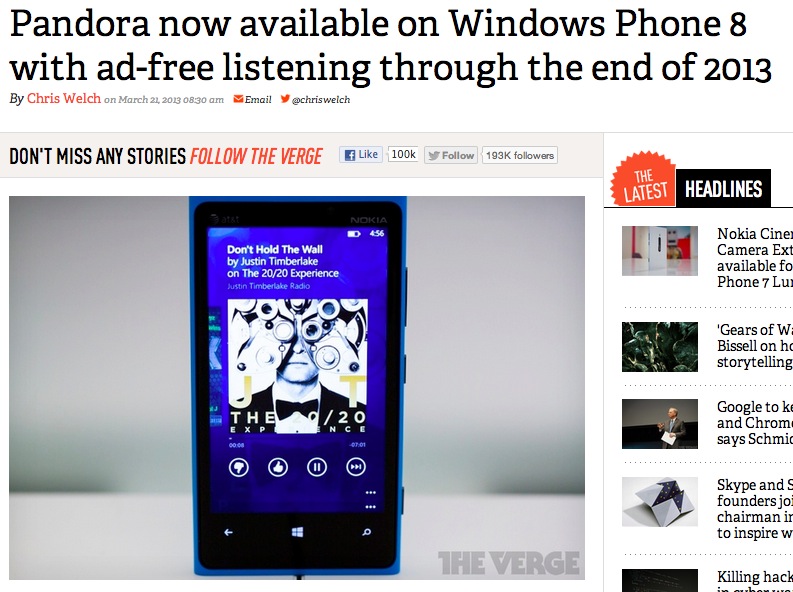
    refurbished phones cheap-Pandora now available fo WP8, available with ad-free listening – “the best way of listening on a smartphone”


    Pandora now available fo WP8, available with ad-free listening – “the best way of listening on a smartphone”-refurbished phones cheap..

    Mylan Cellular | March 22, 2013
    Screen Shot 2013-03-21 at 12.37.12

    I’m not a Pandora but I’ve seen a fair few requests around the web for this to appear on various Nokia platforms.
    It’s now available for WP8, no ads, no limits on streaming – due to a special arrangement with MS (until 2013 ends). Android and iOS users need to subscribe $3.99 to get the same ad-free service.

    For discount cell phones, used cell phones and refurbished cell phones as well as new and used tablets. Please visit our online store.
    It’s just out of the gate, but Pandora for Windows Phone is already the best way of listening to the service on a smartphone.
    Pandora for WP8 takes advantage of WP features such as pinning your favourite stations to the start screen as well as compatibility with Kids Corner (I put Spotify there so my friends can use it without having access to the whole phone) except that this is the first version of Pandora that filters out explicit content.
    The app is apparently missing lyrics  and artist biographies but  they can’t imagine this being a deal breaker.
    qrcode.12382159

     Please visit our ONLINE STORE for a complete selection of discount cell phones, used cell phones, refurbished cell phones as well as new and used tablets.


    Thursday, February 28, 2013

    refurbished phones cheap-Ice Cream Sandwich or Jelly Bean: Which is the Preferred Android Platform?


    Ice Cream Sandwich or Jelly Bean: Which is the Preferred Android Platform?-refurbished phones cheap..

    Android is by far the most popular operating system of the contemporary mobile market in terms of sales and user base. In an attempt to provide the newest and most improved app experience to the existing and potential target audience, Google releases updated versions of its OS platform frequently. Ice Cream Sandwich and Jelly Bean are the newest versions of Android available for use on smartphones.

    Though the names of the updated Android platforms generally attract a larger user base, they do not provide us any idea about the features and functionalities of the operating systems. Mostly, mobile users assume that the latest Android version will be free of bugs and will also have slick additional features. But is it necessary for users to update to the latest version, in spite of the fact that he/she is a non technical person and does not have to access technological features very often? Here we study the comparison of the latest versions of the Android operating system, the Ice Cream Sandwich and the Jelly Bean, to help you decide your choice among the two.

    Ice Cream Sandwich and Jelly Bean: What Has Not Changed

    Firstly, it is important to know the version numbers of both Ice Cream Sandwich and Jelly Bean. The former is Android 4.0, while the latter has two updates 4.1 and 4.2. As the numbers suggest, there has been only a moderate upgradation from Ice Cream sandwich to Jelly Bean. The feel and look of Androids 4.1 and 4.2 are quite similar to that of Android 4.0. The app icons used in both Ice Cream Sandwich and Jelly Bean are completely identical. However, minor changes have been introduced in the status bar and the dock appearing at the top and bottom of mobile device screens respectively. Since there is hardly any change in the behavior of mobile applications as part of both versions of the Android operating system, the number of Android users who upgraded to the latest version is rather small. Till December 2012, mere 6.7 percent users started using the Jelly bean version of Android.

    Ice Cream Sandwich and Jelly Bean: What is New

    According to mobile market researchers, Jelly Bean operates faster on mobile devices when compared to Ice Cream Sandwich. The apps open fast and the web pages also take less time to load on Jelly Bean. The enhanced technology which has been used to build the graphic features of Jelly Bean helps in improving the time of display on the mobile device screen. Rearrangement of icons and widgets on the device home screen is also easier with Jelly Bean. Moreover, a user can resize the widgets as per his/her choice by just dragging them. The most important introduction as part of Jelly Bean is Google Now. This feature behaves like a personal assistant, managing one's settings on the Google searches and fixing appointments, weather, or flight departure schedules. Jelly Bean has also been provided with the ‘cards' option that helps a user get access to information relevant to his/her searches throughout the day.

    To conclude, upgradation to Jelly Bean is not necessary, but can be undertaken by users who use lots of applications, take several photos, or watch videos all day long. The only problem here is that not every Android device runs the Jelly Bean version.

    For discount cell phones, used cell phones and refurbished cell phones as well as new and used tablets. Please visit our online store.

    Refurbished phones cheap-Umimobile clarifies issues regarding UMI X2 purchases


    Umimobile clarifies issues regarding UMI X2 purchases-cheap-cell-phones-online..

    by Mylan Cellular
    Ever since the Umi X2 was launched, people have been clamouring to get their hands on the smartphone and have been facing quite a load of problems when trying to buy it. The phone number on the company’s website doesn’t seem to work, and there has been no response from the given email address. Trying to buy the phone off the websites yields nothing, as there is no option for entering payment methods. But why are people crazy about this device, you ask? Well, it offers insane specs for just Rs 14,000. And we mean full HD 1080p display, a 13 megapixel camera, 32GB of storage type of insane.  

    But things are a lot clearer now, as Umimobile has finally thought to clarify issues on its Facebook Page. It has promised that more updates on the matter will be posted as progress is made.

    The company stated:
    “a) As we are a FDI, in India our legal status is Umi Mobiles Private Limited
    b) Bank Account for order payments will be published once we get all legal processes verified by India Government
    c) Handset review will be done to all portals in India and on this website too
    d) Initial token advance ( for order confirmation) will be taken and based on the production in Shenzhen Factory, dispatches to India retail market will be done
    e) Initial 3 months replacement warranty & 1 year support warranty will be applicable
    f) At present, you can register your details and take order ID< we will personally call and confirm with each & every customer prior payment collection
    g) Online payment via debit card, credit card, net banking will take 10 days to initiate as banks need time to generate Merchant code”

    The UMI X2 has a 1080p display and a quad-core CPU
    The UMI X2—so close and yet so far away


    The UMI X2 runs Android 4.1 Jelly Bean out of the box. We think there will be a few customisations, but looking at the images on the company’s site, it seems the handset is running an almost-stock version of Jelly Bean. The company says it will be upgraded to 4.2 Jelly Bean by April. It is a dual-SIM handset and supports a 3G connection on one SIM, which is pretty standard. Internal storage is capped off at 32GB and UMI has also allowed for a microSD card slot, which supports cards up to 32GB.

    Here’s quick look at the key specifications of the device
    • 5-inch IPS LCD with a resolution of 1920 x 1080 pixels and a pixel density of 441 ppi
    • Dual-SIM, HSPA on WCDMA, GPRS/EDGE on GSM
    • Wi-Fi 802.11 b/g with Wi-Fi hotspot
    • Bluetooth 4.0 with A2DP

    • GPS with A-GPS
    • Accelerometer, proximity sensor, ambient light sensor, magnetic sensor
    • 13 megapixel primary camera with LED flash and 3 megapixel front facing cam
    • 32GB internal memory, with microSD card slot for further expansion up to 32GB

    The UMI X2 brings a quad-core MediaTek MT6589 processor, the same as the one in the Micromax Canvas HD. While it has the same IPS panel as Micromax's Canvas HD, the UMI X2 opts for a full HD resolution. That adds up to 441 pixels per inch.

    Please visit our ONLINE STORE for a complete selection of discount cell phones, used cell phones, refurbished cell phones as well as new and used tablets.

    Wednesday, February 27, 2013

    Refurbished phones cheap-I-mate Working On A Windows 8 Phone Device


    I-mate Working On A Windows 8 Phone Device-Refurbished Phones Cheap..

    imate Windows 8 Phone
    imate Windows 8 Phone docking stationI’m not sure how many of our readers remember i-mate. i-mate was once a Windows Mobile OEM that later went out of business. Now, according to the report from Seattle Times blog, i-mate is working on something interesting that is going to change the way you work and the way you think about your PC and mobile phone.
    It is a new new mobile device with a 4.7-inch touch-screen display running full Windows 8 instead of Windows Phone 8.  This device will be powered by Intel’s Clover Trail Atom processor running full Windows 8 Pro. This unit will be called Intelegent and will go on sale this summer for $750. It will have 2GB of RAM and 64GB of storage. It also sports HSPA+ and LTE 4G wireless networks with up to 10 hours of talk time.
    I-mate will sell the phone alone or as part of  a $1,600 desktop hardware suite including a docking station, called the “hub.” Docked in the hub, the phone can be used with a traditional, wired phone handset or make video calls. It also functions as a desktop PC — powering a 23-inch touch-screen display, keyboard and mouse — and drives an auxiliary wireless tablet with a 10.1-inch, 1080p display


    New Windows 8 PC phone revealed, plus tablet and desktop

    One of the most intriguing new phones being unveiled at this week’s big wireless show in Barcelona, Spain, may be a sleek new Windows model developed in Redmond.
    It’s not coming from Microsoft, which will have a relatively low profile at this year’s   Mobile World Congress.
    The  phone I’m most curious about is being made by a little company in the warren of offices west of Highway 520 between Microsoft and Nintendo. That’s where a few dozen employees of i-mate have built a striking new handset with a 4.7-inch touch-screen display.
    It looks similar to the latest jumbo, slab phones, but it’s a more potent machine inside. The phone runs on  Intel’s “Clover Trail” hardware and Windows 8 Pro, so it’s a full-blown PC capable of running most desktop software.
    Called the Intelegent, the device could go on sale this summer for $750, which is less than the price of an unlocked iPhone 5 with the same amount of storage capacity.
    The phone is more powerful than most tablets. It has an Atom processor, 2 gigabytes of RAM and 64 gigabytes of storage. It’s designed to work with HSPA+ and LTE 4G wireless networks and have up to 10 hours of talk time.
    I-mate will sell the phone alone or as part of  a $1,600 desktop hardware suite including a docking station, called the “hub.”
    Docked in the hub, the phone can be used with a traditional, wired phone handset or make video calls. It also functions as a desktop PC — powering a 23-inch touch-screen display, keyboard and mouse — and drives an auxiliary wireless tablet with a 10.1-inch, 1080p display.
    This isn’t i-mate’s first trip to the rodeo. The company was founded  in 2001 by Jim Morrison, a British Telecom veteran who worked with Microsoft and HTC to launch  early smartphones based on Windows CE.
    The company grew into a major phone producer in the United Kingdom and Dubai before its business tumbled in 2007 and 2008.
    A line of advanced, business-oriented smartphones with  Windows inside was floated in 2007 but sales didn’t pan out.
    Production problems, limited demand and other challenges led the company, based in Dubai at the time, to lay off most of its employees and delist its stock.
    HTC moved on. It transformed from a relatively obscure manufacturer to a prominent consumer brand, in part by taking an early lead with Android phones.
    Two years ago, i-mate’s reinvention began in earnest. The company quietly started developing a new phone based on the Intel silicon.
    The company isn’t setting out to topple the iPhone or Android models that dominate  the smartphone business. Instead it’s positioning itself as a challenger to the BlackBerry, which is also re-emerging with new models aimed largely at business users.
    With tablet sales starting to outpace those of smartphones, and the rise of big phone-tablet “phablets”  like Samsung’s Galaxy Note, perhaps it’s time for a 4.7-inch PC phone.
    Morrison also sees an opportunity to sell corporate users a reasonably priced desktop suite — including a PC, tablet and phone — all powered by the phone.
    He believes corporate buyers will also be interested in a modern phone that can be managed like a PC and run their own PC applications, regaining control they’ve ceded to the closed gardens of Apple’s iOS, Android and even Windows Phone.
    I can’t wait to try the system.
    Maybe I’m just sentimental about the crazy handheld PCs that Paul Allen and others tried to develop a decade ago,   before smartphones took off and PCs were still the gadget tinkerers’ platform of choice.
    Wallet-sized micro PCs like the OQO and the FlipStart that Allen unveiled in 2003  never caught on, in part because they were too expensive and impractical.
    They arrived long before the hardware, software and wireless infrastructure were ready. Morrison said key advances enabling i-mate to produce the Intelegent are Windows 8 and Intel’s Atom hardware, which has just started being used in mobile phones.
    Windows finally starts up fast enough to answer a phone call and its new tiled interface works on the small screen as is, Morrison said.
    “We’ve made it more portable, we’ve combined it with a phone and overall costs have been reduced,” he said. “You’ve got a lot in your package.”
    Morrison said i-mate will  manufacture the phones in the U.S., using screens from South Korea, touch panels from Miami and hardware boards made in Japan.
    A facility in California is ready to assemble 10,000 units a week, he said.
    The company also is benefiting from Intel’s big push to become a player in mobile devices, beyond the laptop. After years of trying, it gained a legitimate toehold in phones  last year.
    Atom-based Android phones went on sale in India, Europe and other  overseas markets, with producers such as Motorola, Lenovo and Acer on board.
    Intel is hoping to pick up the pace with several new hardware systems that it’s announcing Monday in Barcelona.
    They include a new Atom processor dubbed Clover Trail Plus, with double the computing power and three times the graphics capabilities as the Clover Trail model that launched in September.
    The new Intel processors are designed for phones and tablets, including a wave of new Android tablets coming out in the next few months and some lower-cost Windows devices.
    So far, i-mate appears to be the first to use Intel hardware to build a phone running Windows 8. Intel has been helping out by providing engineering support, spokeswoman Kathy Gill confirmed.
    “It’s an exciting time for mobile technology in general as you see these smartphones becoming more powerful and people wanting to do more and more with their mobile devices,” she said.
    Whether this leads to a single device powering all the gadgets in the office remains to be seen.
    Intel and Microsoft would probably prefer that people continue buying a phone, a PC and a tablet rather than an all-in-one like i-mate’s Intelegent.
    Even so, i-mate is likely the first of multiple companies that will try again to help people converge or consolidate their devices, taking advantage of PC hardware that finally has the right combination of small size, battery efficiency and wireless capabilities.
    Meanwhile i-mate is off to Barcelona to find partners such as wireless carriers to help launch its device this summer.
    No doubt, it’s a longshot. We’ll also have to see if the system works as well as it looks.
    But  it’s hard not to get excited about the company’s concept and verve.


    Please visit our ONLINE STORE for a complete selection of discount cell phones, used cell phones, refurbished cell phones as well as new and used tablets.


    Monday, February 25, 2013

    Refurbished phones cheap-Hands-on video of the Nokia Lumia 520 and Nokia Lumia 720

    Hands-on video of the Nokia Lumia 520 and Nokia Lumia 720-Refurbished-Phones-Cheap...